

Does Missouri Require Notice Before an ADA Website Lawsuit?
Missouri's new law sets no notice a plaintiff must send before suing over website accessibility. What it does set: a way to ask a court to rule a suit abusive, and 90 days in which a fix can count, if the court finds it held.
Rick Hensbergen5 minute read
A letter arrives, and 90 days can begin
A letter reaches a business in Missouri, or a county office, saying a person using a screen reader could not get through its website, and a suit under the ADA or state law may follow. Since August 28, 2026, a Missouri law gives the organization a way to ask a court whether that suit is abusive, and a reason to fix the barrier and keep the dates.
The law is section 537.1250 of the Revised Statutes of Missouri (opens in a new tab), the "Act Against Abusive Website or Web Content Access Litigation". Senator Brad Hudson sponsored the bill (opens in a new tab), and the governor approved it on May 7, 2026 (its record (opens in a new tab) is on the Missouri House's site).
Section 537.1250 sets no notice that has to be sent before a suit is filed. Notice comes in later, as one of the factors a court weighs.
Who can ask the court
The attorney general, for a class of residents, or "any resident of this state who is subject to litigation that alleges any website or web content access violation" may file a civil action in a Missouri court "against the party, attorney, or law firm that initiated such litigation."
A resident, under the section, is any individual living in Missouri, any entity registered with the Missouri Secretary of State, or the state and its political subdivisions. A company based elsewhere counts if it is registered in Missouri, and so do cities, counties, and state agencies. The suits covered are those alleging that a website fails the accessibility requirements of the ADA or of state law.
What the court weighs
The court looks at the whole picture to decide whether the suit's primary purpose "is obtaining a payment from a defendant due to the costs of defending the action in court." Among the factors: whether the same plaintiff or firm has filed many similar suits without real effort to improve accessibility, any history of sanctions or bad faith, how settlement talks went, and "Whether the plaintiff provided the defendant with reasonable notice and an opportunity to correct the alleged barrier prior to filing suit."
The 90 days, and who decides a fix is real
The center of the section is its "Safe Harbor Provision": "A defendant who receives written notice of an alleged website or web content access violation and in good faith initiates substantial steps to correct it within ninety days shall have a rebuttable presumption that any subsequent claim for a website or web content access violation is abusive."
The same subdivision sets its limit. No presumption arises "if the alleged website or web content access violation is not corrected, as determined by the court, within ninety days after being provided written notice or being served a petition or complaint with sufficient detail to identify and correct the alleged access violation."
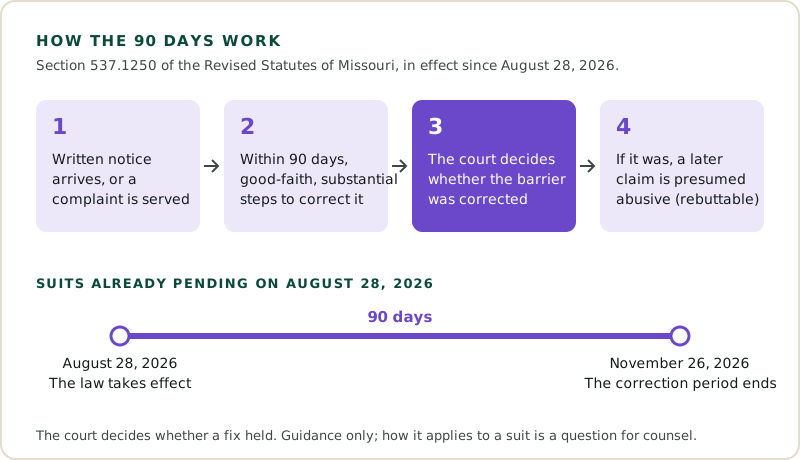
Three consequences follow. The 90 days can start with a letter or a served complaint. The fix has to hold, because the court decides whether it did. And abuse is decided only after the 90 days end or the barrier is corrected.
Suits already pending
The section reaches back: "This section shall apply to litigation pending on August 28, 2026." The Safe Harbor Provision also covers a defendant in a pending suit that met its terms before that date, "or that is within the ninety-day correction period after August 28, 2026." Ninety days after August 28 is November 26, 2026.
November 26 is close. The work is often smaller than a complaint makes it look. A barrier named in a complaint often traces to one template or one form, and a single change there carries to every page built on it, as How much work is it to fix website accessibility? shows for a typical site.
What it can cost, and when it ends
If a suit is found abusive, the court may award reasonable attorney's fees and costs, "to be paid by the party bringing the abusive litigation," and "punitive damages or sanctions not to exceed three times the amount of attorney's fees awarded by the court."
The section has an end written in. If the U.S. Department of Justice issues website accessibility standards under Title III of the ADA, and the attorney general notifies the state's revisor of statutes, the section expires for registered entities and for the state and its political subdivisions.
What this means for your own site
In Missouri, a fix made within 90 days now counts in court, and the organizations that can use it are the ones that can show the dates.
- When a letter or complaint about accessibility arrives, is the date it arrived recorded that day?
- Is the barrier it describes fixed, then checked again with a keyboard and a screen reader, rather than only marked as closed?
- Could the organization show a court, with dates, what was found, what changed, and when it was checked again?
Esther assesses a site and dates every finding. A barrier can be on the record before any letter names it, and a fix shows from the day the barrier stops being found. What this looks like for a Missouri business is at For business, and for a city, county, or other public body at For government.
Everything above is general guidance on section 537.1250. How it applies to a particular suit is a question for the organization's counsel.
Sources: section 537.1250 of the Revised Statutes of Missouri, as published by the Missouri Revisor of Statutes, and the truly agreed and finally passed text of HCS SS SCS SBs 907, 1154 & 1272 (2026), with its sponsor, approval date, and effective date from the Missouri House's bill page for SB 907. Read October 26, 2026.
About the author

Rick Hensbergen is the founder and CEO of Esther. He has spent his career in governance and risk, twenty years of it at major banks in the United States and the United Kingdom, including as a Senior Manager approved by the UK's Financial Conduct Authority.