

Unable to Send Money: The Accessibility Suit Over Chase's Website
A man who is legally blind says he could not send money on Chase's website with his screen reader. What the court record shows about where the suit started, what it asks for, and what happens next.
Ash Harris5 minute read
The suit
On September 11, 2026, a man who is legally blind filed a proposed class action against JPMorgan Chase Bank, N.A. in the Supreme Court of the State of New York, Rockland County. The case is Biberfeld v. JPMorgan Chase Bank, N.A. (opens in a new tab), state index No. 037199/2026.
What the complaint says comes from Chase's own court filing, which quotes it. The plaintiff says he is "visually impaired and legally blind." He says that throughout 2026 he visited Chase's website using "a popular screen reading software called Voice Over." He says Chase failed "to maintain and operate its website in a way to make it fully accessible for himself and for other blind or visually-impaired people."
The harm he names is specific. He says he was "unable to send monies because the website is inaccessible to Plaintiff's reading assistant technologies."
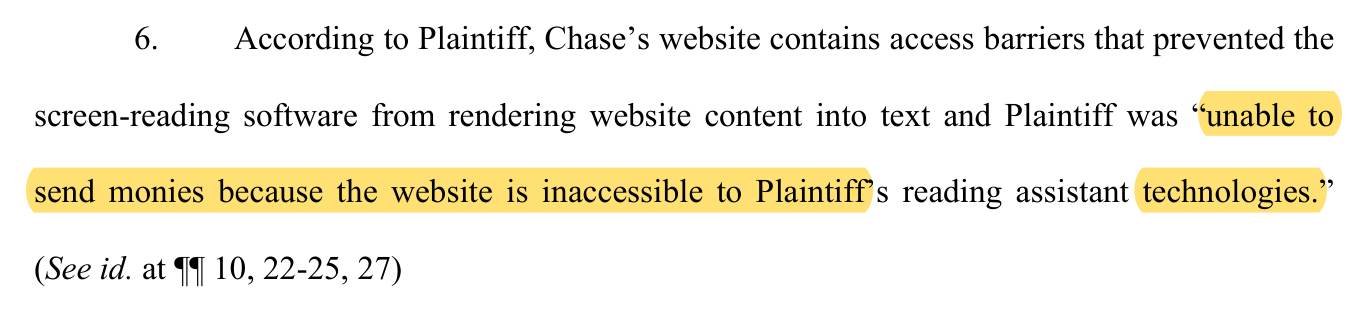
The complaint's descriptions are allegations. Chase's filing says it "neither admits liability nor concedes the accuracy" of them.
It started in a state court
The suit makes three claims: a claim under Title III of the Americans with Disabilities Act, a claim under New York's Civil Rights Law, and a request for a declaration. It asks the court to order Chase to make its website accessible. It also asks for statutory and punitive damages and attorneys' fees. He brings it for himself and for a proposed class of "All legally blind individuals in New York who have attempted to access Defendant's Website and as a result have been denied access to the equal enjoyment of services during the relevant statutory period."
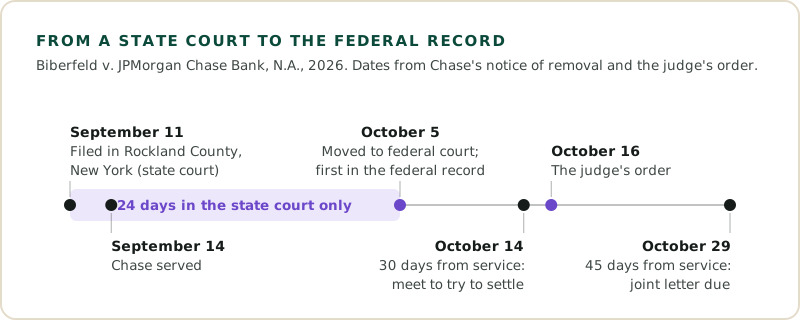
Chase was served on September 14. On October 5 it moved the case to the federal court for the Southern District of New York, where it is now No. 7:26-cv-08778, because the complaint includes a federal claim. For the 24 days in between, the case sat only in a state court's records, out of sight of any count of federal accessibility filings.
Chase's filing also keeps open its right to ask the court to send the case to arbitration, "to the extent provided by any applicable agreement and governing law."
What happens next
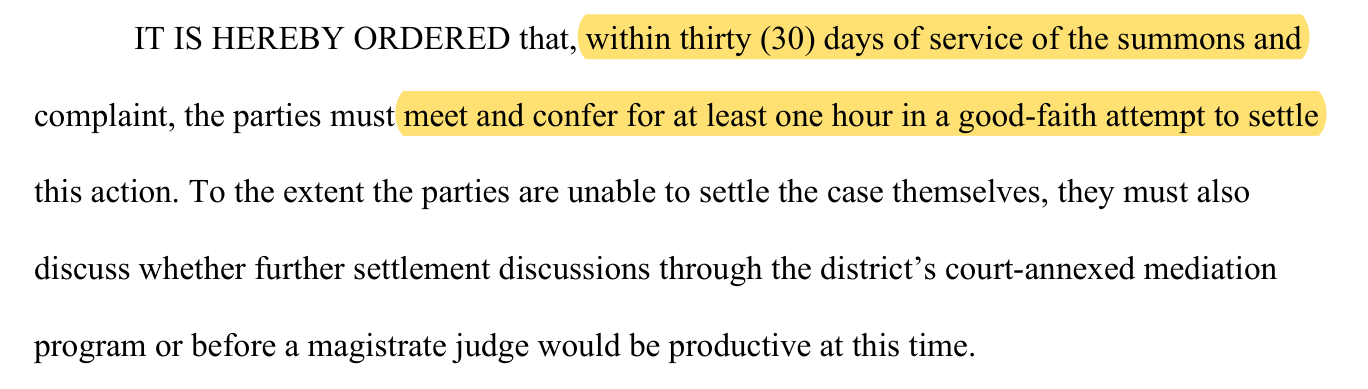
On October 16, the judge ordered the two sides to meet for at least an hour, within 30 days of service, "in a good-faith attempt to settle this action." Within 45 days of service, they must tell the court whether they have settled. If they have not, they must ask the court either to send the case to mediation or a settlement conference, or to hold a first pretrial conference.
Counted from service on September 14, those dates are October 14 and October 29, so the first had passed by the time the order was signed. Its text names only the parties: it sets out the first steps the case must take.
What this means for your own site
The barrier in this complaint is in the task he came to do. Sending money, paying a bill, booking, and checking out are the steps where a barrier stops someone completely, and this complaint names one of them.
- Can someone using a screen reader finish each task your site exists for, from start to end? A home page that passes a check says nothing about the payment form behind it.
- Is that task checked again after each change? Forms and payment steps are rebuilt often, and one release can undo an earlier fix.
- Can you show when each barrier was found and when it was fixed? A dated record lets you answer a demand letter by showing what was found and when it was fixed.
If you use a screen reader, the complaint describes something you may know well: a site that loads, but a task you cannot finish.
Esther assesses a site, including the steps people take to get something done, and dates every finding, so a barrier is seen before someone else finds it, and a fix can be shown. What this looks like for private organizations is at For business, and for public bodies at For government. How much work a typical website needs is in How much work is it to fix website accessibility?
Sources: Chase's Notice of Removal (Document 1, filed October 5, 2026) and the court's order of October 16, 2026 (Document 7) in Biberfeld v. JPMorgan Chase Bank, N.A., No. 7:26-cv-08778, U.S. District Court for the Southern District of New York, read from the court's own filings. The case name above links to its public court record.
About the author

Ash Harris is Esther's Chief Global Growth Officer. He has worked in web accessibility for twenty years, advising government, global banks, major retailers, and universities, and served on the W3C's Education and Outreach Working Group from 2018 to 2023.