

Is WCAG 3 a Standard Yet?
W3C updated its WCAG 3 draft on September 10, 2026, and calls it an incomplete draft that will change. Most of the rules websites answer to today are based on WCAG 2.
Ash Harris4 minute read
What a WCAG 3 claim is worth today
An accessibility report, a vendor's proposal, or a contract may now mention WCAG 3. Any claim made against WCAG 3 measures a website against a draft. The World Wide Web Consortium (W3C), which writes the guidelines, calls WCAG 3 "an incomplete draft that will change." Its own introduction to WCAG 3 adds, "The final requirements in WCAG 3 will be different from this draft."
When a complaint or a demand letter arrives, the question is which rules apply to the organization. W3C separates the two itself, in a blog post of September 25, 2026: W3C "provides the ruler with WCAG. W3C does not write the rules." The rules are the laws, regulations, and policies that require accessible websites. Of those, the post says, "Most are based on WCAG 2."
Where the draft stands
On September 10, 2026, W3C published an updated Working Draft of WCAG 3.0 (opens in a new tab). The W3C Accessibility Guidelines, as WCAG 3 is named, have been a public draft since January 21, 2021, and the September version is the tenth. Its status section says, "Publication as a Working Draft does not imply endorsement by W3C and its Members."
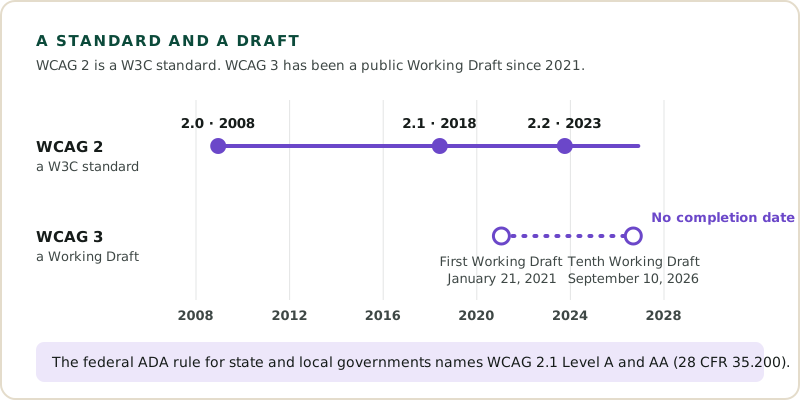
W3C's WCAG 3 Introduction (opens in a new tab), updated on September 25, 2026, names no completion date. It says only that WCAG 3 "is not expected to be a completed W3C standard for a few more years." The same page says "WCAG 3 will not supersede WCAG 2 and WCAG 2 will not be deprecated for several years after WCAG 3 is finalized."
What the rules ask for now
For state and local governments, the Department of Justice's ADA rule names the version outright. Its web accessibility section (opens in a new tab) requires the "Level A and Level AA success criteria and conformance requirements specified in WCAG 2.1." No federal regulation sets a specific web standard for private organizations. Claims against them are filed routinely all the same.
The September draft itself expects WCAG 2 to last: it "is used around the world and will still be required by different countries for a long time to come." Work done against WCAG 2 carries forward, because W3C says "WCAG 3 will have similar accessibility requirements as WCAG 2." Its advice is direct: "The best way to prepare for WCAG 3 in the future, is to meet WCAG 2.2 success criteria now."
What W3C says is changing
The differences are in how the guidelines are organized and how conformance works.
- Scope. "WCAG 3 applies to web content, apps, tools, publishing, and emerging technologies." The new name, W3C Accessibility Guidelines, was chosen "to encompass the broader scope beyond 'content'."
- Structure. Guidelines are written as outcomes, with core requirements, supplemental requirements, assertions, and recommended practices beneath them.
- One level of conformance. "For a specified conformance scope to conform to WCAG 3, all core requirements MUST be satisfied." The core requirements build on WCAG 2.2 Level A and AA, according to the blog post, written by Shawn Lawton Henry, Director of the W3C Web Accessibility Initiative.
- Tags and tiers. Each core requirement carries a tag for what happens to a person with a disability when it isn't met: Physical Harm, Risk, Barrier, or Friction. A Barrier requirement is one where failing it "can prevent someone with a disability from proceeding." Six reporting tiers built on the tags show progress below conformance and beyond it.
The blog post says the draft "further separates conformance to WCAG from details that can be addressed by policies." Regulators could then use the tags to ask for "more requirements for essential government services and fewer requirements for less important websites." W3C is asking for review of the model, and its Explainer sets out an alternative based on scoring.
What this means for your own site
The questions worth asking now are about today's rules.
- When a report or a vendor mentions WCAG 3, which draft is it measured against, given that W3C says the final requirements will differ?
- Does the site meet the WCAG 2.2 success criteria, which W3C calls the best preparation for WCAG 3?
- Is there an independent, dated record of what was checked on the site, and when? A claim against a draft that will change can't show that.
- Which barriers on the site would stop a person from finishing a task, and which only slow them down? The draft's Barrier and Friction tags draw the same line.
People who use a screen reader or other assistive technology can comment on the draft too. W3C asks especially about the conformance model, and the WCAG 3 Introduction explains how to take part.
Esther assesses a site and dates every finding, so there is a record of what was checked and when. Public bodies can start at For government, and private organizations at For business. An earlier article looks at how much work it takes to fix a typical website.
Sources: the W3C Working Draft of WCAG 3.0 of September 10, 2026, and its publication history; W3C's WCAG 3 Introduction, updated September 25, 2026; the W3C blog post "Crafting WCAG 3 for more accessible user experiences" of September 25, 2026; and 28 CFR 35.200. All were read on October 26, 2026.
About the author

Ash Harris is Esther's Chief Global Growth Officer. He has worked in web accessibility for twenty years, advising government, global banks, major retailers, and universities, and served on the W3C's Education and Outreach Working Group from 2018 to 2023.