

Sued Again: Why Settling an Accessibility Suit Doesn't Fix the Website
One shoe brand's website was sued over accessibility in 2022, 2024, and 2026, each time by someone new. What the court record shows about why settling one case doesn't end the exposure.
Ash Harris5 minute read
Three suits, one website
Merrell sells hiking boots and outdoor shoes online. The brand belongs to Wolverine World Wide, Inc. In the federal court in Manhattan, the U.S. District Court for the Southern District of New York, the brand's website has been the subject of three lawsuits, each with a claim under Title III of the Americans with Disabilities Act:
- Loadholt v. Wolverine World Wide, Inc. (opens in a new tab), No. 1:22-cv-04622, filed June 3, 2022.
- Sumlin v. Wolverine World Wide, Inc. (opens in a new tab), No. 1:24-cv-07567, filed October 6, 2024.
- Simmons v. Wolverine World Wide, Inc. (opens in a new tab), No. 1:26-cv-08375, filed September 25, 2026.
A different person brought each one, through a different law firm. Each makes the same complaint: someone using a screen reader could not shop the site.
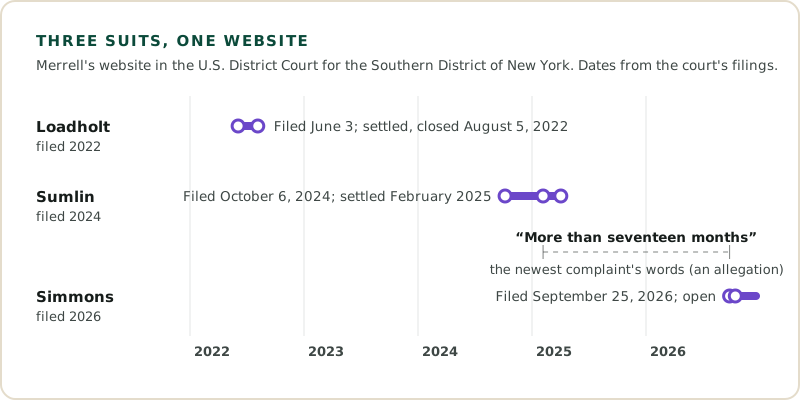
The first two cases closed. The newest says the barriers are still there
Loadholt closed in August 2022, after the court was told that all claims had been settled. Sumlin was settled in principle in February 2025, and dismissed with prejudice in April 2025. Neither settlement's terms appear in the court filings we could read.
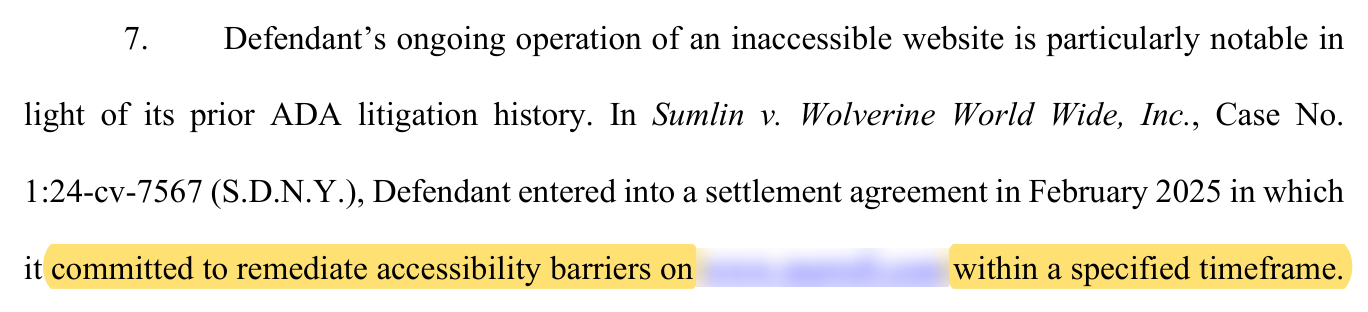
The newest complaint fills in part of the gap, as an allegation. It says that in the Sumlin settlement the company "committed to remediate accessibility barriers on [Merrell's website] within a specified timeframe," and that "more than seventeen months have passed since that agreement, yet Defendant has failed to implement any meaningful accessibility improvements."
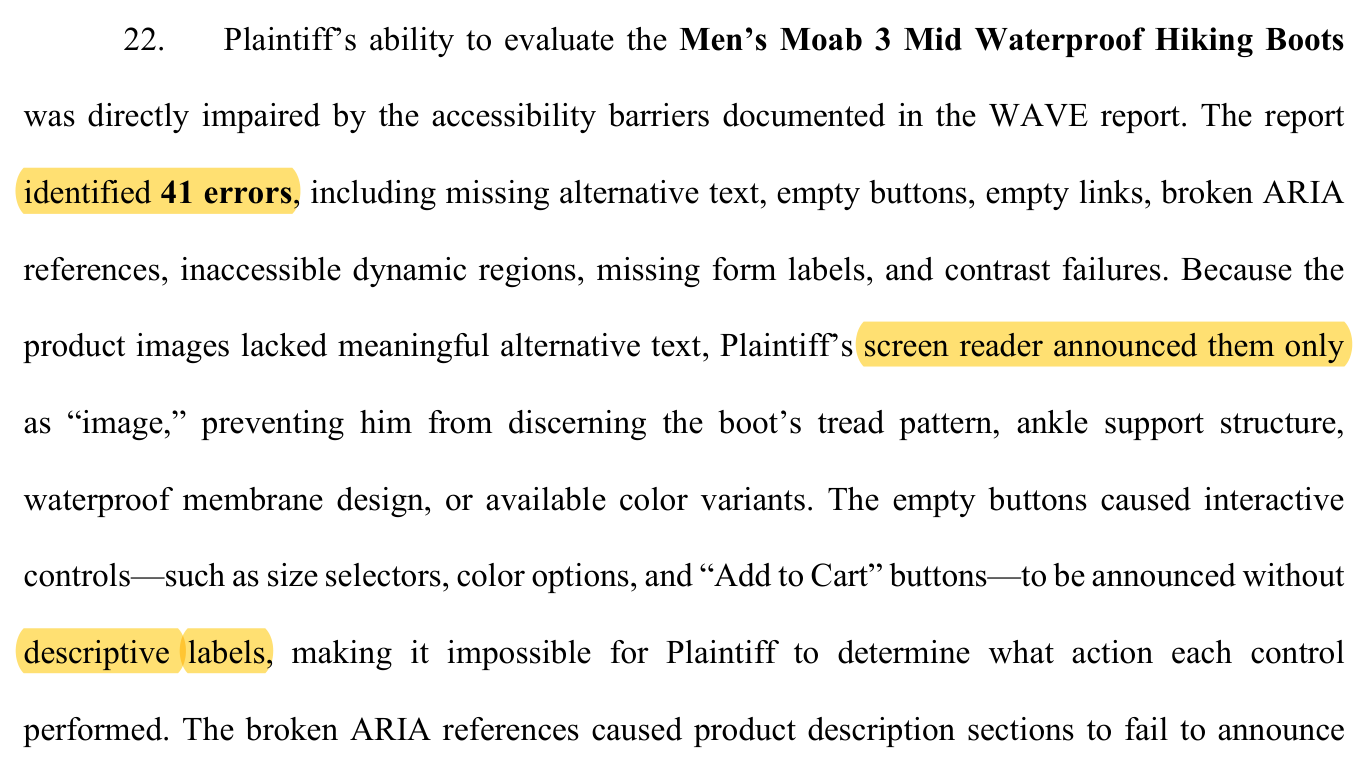
It then describes what the plaintiff met on the site: "missing alternative text, empty buttons, empty links, broken ARIA attributes, inaccessible dynamic regions, unlabeled interactive controls, and contrast failures." On a product page, it says, the images were announced only as "image," and the size, color, and Add to Cart controls were announced without labels.
The complaint's evidence for this came from automated audits with a free online checker, which it says reported 41 errors on a single boot's product page. A site's owner can run the same kind of check and see what the plaintiff saw, before a complaint quotes it.
The complaint's descriptions are allegations, not findings. The case is open, and on October 13, 2026, the court referred it to a magistrate judge for pretrial matters, including settlement.
What a settlement ends, and what it leaves open
A settlement binds the people in that case. The next person who arrives at the same page with a screen reader and meets the same unlabeled button is outside it. On this record, that next person came twice, each time with a different firm.
The earlier settlement also changed what the next complaint could say. The newest complaint uses it as evidence that the company knew: having agreed to fix the site, it "cannot credibly claim ignorance" of what the law requires. A commitment that is not met does not stay in the past. It is quoted back.
What this means for your own site
If your organization has settled an accessibility claim, the questions that matter now are practical ones:
- Were the barriers named in the claim actually fixed, and is there a date that shows it? A settlement closes a case; only the site itself shows whether the problem is gone.
- Is the site checked again after changes? Product pages, menus, and checkout steps change often, and a fix to one template can be undone by the next release.
- If a fix was promised, can you show when it was made? A dated record answers the next demand letter with evidence instead of an argument.
If you use a screen reader, these complaints describe what you already know: images with no description, buttons with no name, choices you cannot hear. The record here shows the same barriers can sit on a large retailer's site across several years and several lawsuits.
Esther assesses a site and dates every finding, so a fix that held can be shown, and one that slipped back is seen before someone else finds it. What this looks like for private organizations is at For business, and for public bodies at For government. How much work a typical website needs is in How much work is it to fix website accessibility?
Sources: the complaints, orders, and dismissals filed in Loadholt v. Wolverine World Wide, Inc., No. 1:22-cv-04622; Sumlin v. Wolverine World Wide, Inc., No. 1:24-cv-07567; and Simmons v. Wolverine World Wide, Inc., No. 1:26-cv-08375, all in the U.S. District Court for the Southern District of New York, read from the court's own filings. Each case name above links to its public court record, with the filings themselves.
About the author

Ash Harris is Esther's Chief Global Growth Officer. He has worked in web accessibility for twenty years, advising government, global banks, major retailers, and universities, and served on the W3C's Education and Outreach Working Group from 2018 to 2023.